06.11.2026
Usability Testing Lab or Remote Testing?
Why on-site observation often reveals more
by Werner Baum (UID)
After conducting hundreds of usability tests, one thing never ceases to surprise me: the most valuable insights rarely come from what people say. They emerge in those few seconds of hesitation, searching, or trial and error. That’s exactly why, even today, I still consider the usability testing lab to be one of the most important tools in UX research.
Over the past few decades, I’ve observed countless users interacting with digital products. Many of these studies took place remotely, while others were conducted in our usability testing lab. Both approaches have their merits. Nevertheless, I repeatedly encounter situations where direct on-site observation yields insights that are virtually impossible to capture remotely.
At first glance, it often seems simple: A person clicks through an application, completes their tasks, and explains their thought process along the way. But the truly fascinating insights often emerge between the actual actions. A quick glance at the screen. A moment of hesitation. Searching for a specific feature. Rereading a text. Such situations sometimes last only fractions of a second, but they often reveal more about the quality of a user interface than a lengthy concluding comment.
Especially with complex applications, I regularly observe that users don’t even identify problems at first. Instead, they try to resolve the situation on their own. From the outside, it’s clear how they try different approaches, compare options, or slowly work their way toward a solution. It’s precisely these behavioral patterns that help me understand the root causes of usability issues.

When direct observation reveals more than statements do
One thing has been confirmed time and again for me over the years: Users don’t always say what they’re thinking, and they don’t always notice what’s causing them difficulties. This becomes particularly evident in applications with high demands on safety, precision, or process understanding. These include, for example, medical technology, industrial applications, or complex B2B software. In these contexts, even a small uncertainty can have significant implications for the rest of the process.
In the lab, I can analyze such situations in great detail. Multiple camera angles, screen recordings, and audio recordings make it possible to reconstruct all relevant aspects of a usage scenario and evaluate them later together with the project team.
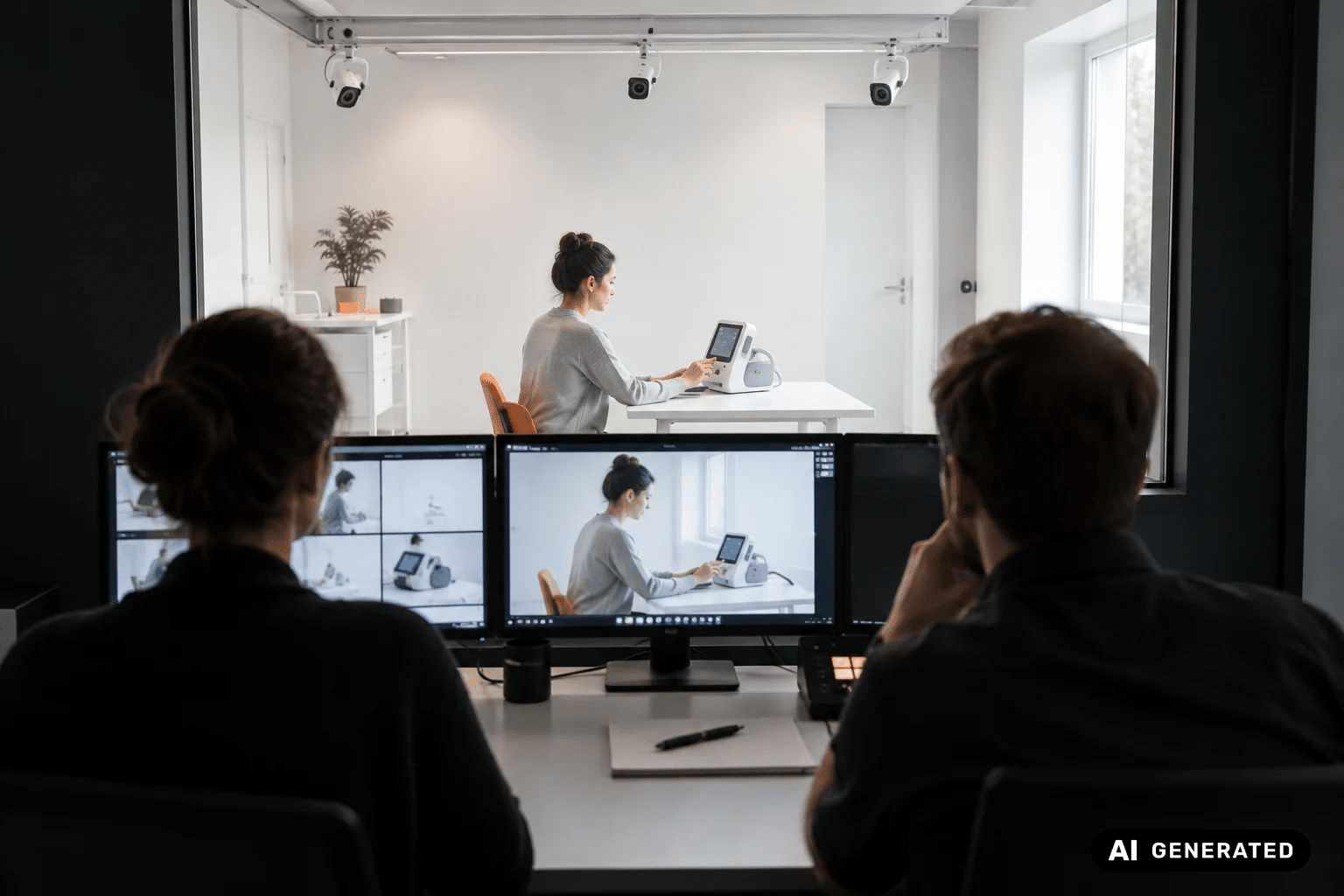
Typical setup of a usability testing lab
| Component | Function |
|---|---|
| Test room | Performing realistic user tasks |
| Multiple cameras | Recording of users, the product, and the work surface |
| Screen recording | Documentation of digital interactions |
| Audio recording | Recording of think-aloud comments |
| Observation room | Live observation by stakeholders |
When products are more than just software
Another point I frequently encounter in projects: Many products do not consist solely of a digital interface. Especially with medical devices, consumer electronics, or technical equipment, users interact simultaneously with hardware, packaging, instructions, and software interfaces. To understand how people interact with this entire system, a screen recording alone simply isn’t enough. In the lab, I can observe how information is transferred between different components, where misunderstandings arise, and what role the physical environment plays. It is precisely when addressing such questions that the most valuable opportunities for optimization often emerge.
Why smartphone apps also benefit from the test lab
At first glance, this might seem surprising: After all, smartphone apps can be tested remotely without any trouble these days. In my experience, however, there are many situations in which a lab test provides additional insights. When it comes to mobile applications, I’m not only interested in whether someone can find a feature, but also in how the interaction takes place:
- How is the device held?
- Which parts of the display are overlooked?
- How does hand posture change during a task?
- Is content obscured by the fingers?
- How often do users have to switch back and forth between different views?
These details play a crucial role in the user experience and can be observed much more effectively in a lab setting.
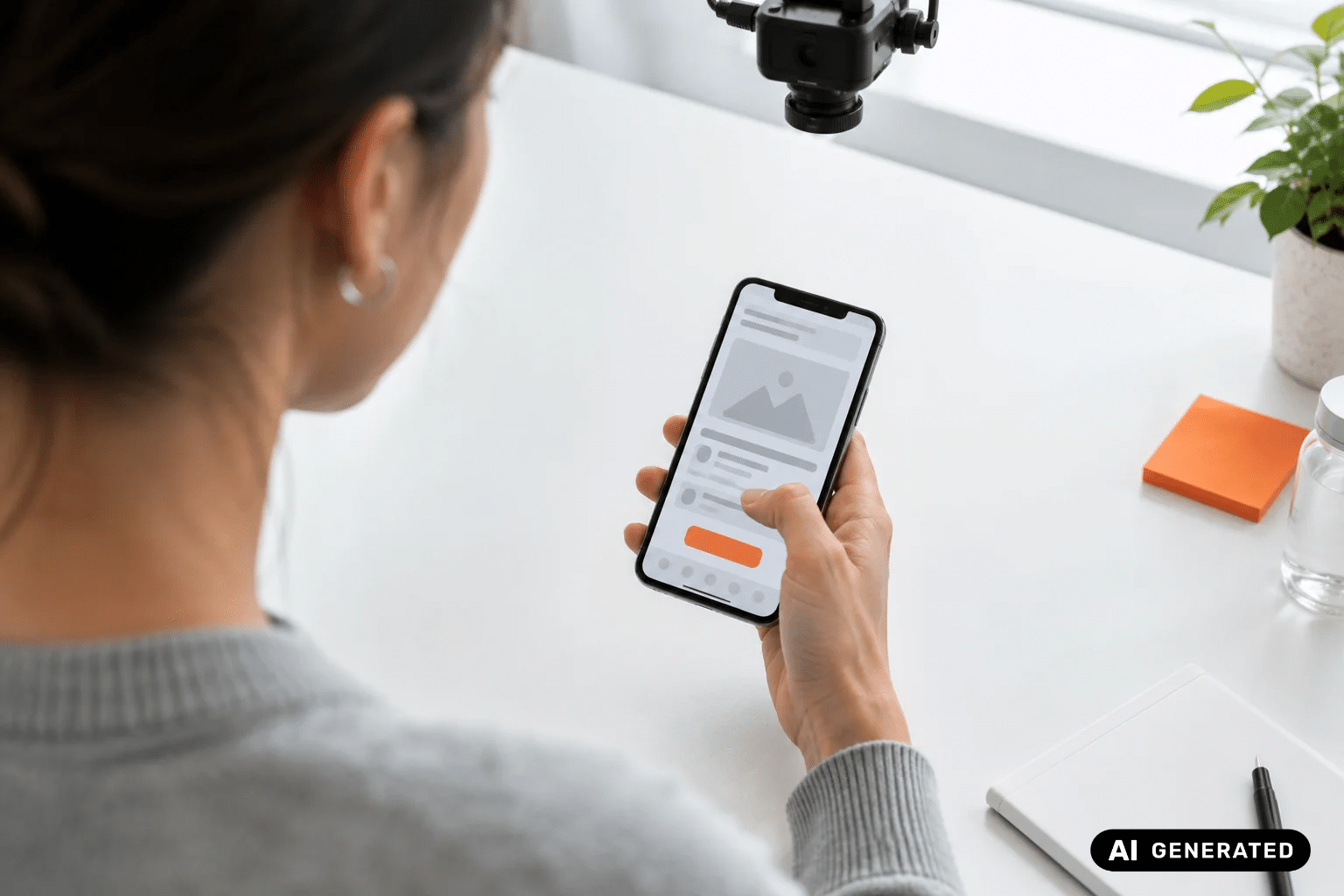
In addition, typical usage scenarios can be specifically simulated—such as using a banking app under time pressure, operating a mobility app while navigating, or using a health app in combination with medical devices. This reveals how robust an interaction design is even under realistic stress conditions.
Particularly for medical, banking, industrial, or mobility apps, this approach helps identify usability barriers that would otherwise go undetected in a simple success metric analysis. That’s why we specifically recommend lab-based app testing to clients in these industries.
Specialized technology for mobile UX testing
| Component | Benefits |
|---|---|
| PTZ dome camera | Capturing hand movements and gestures |
| Front-facing camera | Observing facial expressions and reactions |
| Live streaming | Observation by stakeholders |
| Synchronized video analysis | Combining all perspectives |
What really matters in a good lab-based usability test
As valuable as a usability testing lab may be, in my experience, the quality of the findings depends not only on the recording technology but, above all, on the methodology used to conduct the test.
I rarely find that the most interesting observations arise simply because state-of-the-art cameras are installed or every movement is recorded. What matters much more is whether we can create a situation in which participants behave naturally and, as much as possible, forget that they are being observed.
That’s why, for me, a successful usability test begins long before the actual test date. Clear research questions, realistic scenarios, and the selection of suitable participants form the foundation for meaningful results. If the wrong people are invited or the tasks are phrased too artificially, even the best recordings are of limited use.
Facilitation plays a central role during the test. As a facilitator, I try to influence the participants’ behavior as little as possible. The trick is to guide the participant confidently through the session without giving hints or unintentionally steering the direction. After all, it’s not the perfect execution of a task that yields insights, but rather the natural process of solving the task.
Another key factor for success is the design of realistic usage scenarios. The closer a task is to actual real-world use, the more meaningful the results are. Instead of asking about individual functions, I therefore prefer to work with concrete scenarios and tasks that, ideally, could be drawn from the users’ real-life daily routines.
Especially in laboratory studies, it’s also worthwhile to closely involve stakeholders. This gives developers and product managers the opportunity to experience observations firsthand. However, it is important to keep observations and interpretations separate. Not every difficulty automatically indicates a design problem, and not every single observation justifies a product change on its own. Only a systematic analysis of multiple test sessions allows for reliable conclusions.
Remote or in the lab? The wrong question
Despite all the advantages of the lab, remote testing is by no means the inferior alternative. It is particularly well-suited for international target audiences, early-stage concept evaluations, rapid iterations between development cycles, or projects with limited budgets. Even when the focus is on the natural context of use, remote testing may be the more appropriate approach. In my view, the key question is therefore not which method is superior. Rather, what matters most is what insights are needed.
Conclusion
After many years in user research, there’s one realization that keeps being confirmed for me: The most exciting insights rarely come from the participants’ answers, but rather from their actual behavior. For those who want to not only document user problems but also truly understand their causes, the usability testing lab remains one of the most effective tools in modern UX research.
The author
Werner Baum is Senior User Experience Consultant and heads our medical testing laboratory in Munich. He has 25 years of experience in the field of user experience. His work focuses on user research and the execution of international research projects, as well as the design and evaluation of user interfaces. He brings extensive experience with various research methods and international evaluations in the medical field.