
16.06.2026
AI in User Research: Efficiency Through Human-in-the-Loop
AI is transforming the way user research is prepared, conducted, and analyzed. When used correctly, it speeds up routine tasks, makes qualitative data easier to organize, and frees up more time for what really matters. UID uses AI in a targeted and responsible manner: with methodological expertise, a commitment to data protection, and a consistent “human-in-the-loop” approach. We’ll introduce you to our project practices and show you how to design better digital products using more efficient research processes and robust UX research.
AI as a tool, not a shortcut

For us, AI is not an end in itself, nor is it a shortcut to quick answers. We use it as a tool that can effectively complement professional UX research processes: from preparation and documentation to the initial structuring of qualitative and quantitative data.
Reliable research results do not come about through the use of AI alone. In qualitative research in particular, reliable results are achieved through an understanding of the context, the interviewer’s methodological expertise, and critical analysis during the evaluation process. While AI can provide support in this area, it cannot replace research expertise or research in general. That is why, at UID, the interpretation of findings is always the responsibility of experienced UX researchers.
Our principles for the use of AI
- We use AI in a deliberate and professionally informed manner. Results are reviewed and evaluated, rather than accepted at face value.
- We protect customer, project, and user data and take into account customer-specific data protection and security requirements.
- We use AI wherever it improves research processes—by increasing efficiency, improving structure, or enhancing traceability.
AI in Usability Testing
Using Usability as an Example testing clearly illustrates where AI adds value creates without methodological responsibility to :: Data faster to structure, and to and and polish the wording.
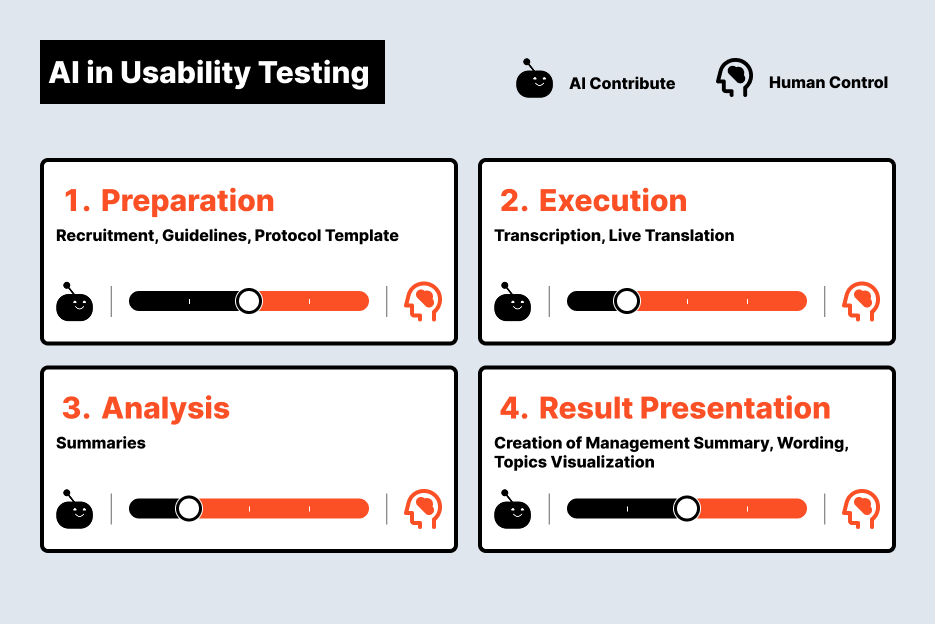
| Area | AI supports… | Quality assurance through UID |
|---|---|---|
| Preparation | • Recruitment: Drafting of screening questions, variants, and inclusion and exclusion criteria • Guidelines: Structuring, question variants, and bias check • Protocol: Creation of a template based on the guidelines |
• Review for target group suitability and client-specific requirements • Methodological review of sequence, clarity, and coherence • Check for completeness and consistency |
| Implementation | • Transcription • Markers and chapters • Live translation |
• Review of consent forms and data protection • Assessment of nuances of meaning and context • Moderation remains human |
| Analysis | • Summaries • Clustering • Identification of initial patterns |
• Comparison with raw data • Critical interpretation and prioritization |
| Presentation of Results | • Formulation • Management Summary • Visualization of initial topics |
• Technical synthesis into reliable findings • Development of concrete recommendations |
Quality and safety as an integral part
AI-driven analysis is only valuable if it is controlled, traceable, and subject to expert review. This is because AI results can be incomplete, biased, or overly simplified, especially when dealing with complex qualitative data.
That is why we work with clear quality standards:
- Structured protocols and clean data sets
- Targeted prompts and specific analysis questions
- Step-by-step analysis instead of black-box results
- Verification of key statements against raw data and quotes
- A Consistent Human-in-the-Loop Approach
- Privacy and security requirements from the very beginning
The added value for our customers

For our clients, AI-powered user research means one thing above all else: more efficient processes and more robust insights while maintaining consistently high methodological quality.
- More efficient preparation of screening tools, guidelines, and protocols
- Greater transparency through transcripts, markers, and verifiable quotes
- More time for analysis, prioritization, and strategic recommendations
- Secure processes through clear data protection and quality standards
- Reliable decisions based on user insights analyzed from a technical perspective
- More transparent collaboration with stakeholders in the research process
AI helps us free up time for what really matters UX Research : understanding users and specifically improve digital products. This enhances the effectiveness of research activities for the project.
What sets AI-powered research at UID apart
UID combines AI-driven methodologies with years of expertise in UX research and consulting. This results in research findings that are efficiently gathered, reliably processed, and translated into concrete product decisions based on sound professional expertise.
Want to know how your product can benefit from AI-powered user research? Talk to us about your research project!
The author
Carina Völpel has been working as a Senior User Experience Consultant at UID for over 15 years. She analyzes user requirements, designs and evaluates interaction concepts for interactive products, and primarily advises clients from industry and the enterprise sector on UX strategy. In her workshops, she acts as a facilitator, combining agile methods such as Design Thinking and LEGO® SERIOUS PLAY® to embed user-centered thinking in teams and organizations.

More on the topic
- Kostenfreie UID Live Sessions zu den wichtigsten Trends um digitale Produktentwicklung (in German)
- UID Masterclasses zum User Centered Design, Journey Mapping, Designsysteme und Interaktionsgestaltung (in German)
- User Research
- UX Enablement
- Insight: Added value instead of hype: how human-centered AI succeeds
- Insight: The cost of poor User Experience
- Subscribe to the UID Newsletter (in German)