
18.05.2026
When good apps go one step further
Good apps don’t stop at the smartphone. They continue to accompany users precisely when brief eye contact, simple actions or speech make the difference. Not every app belongs on a smartwatch. And not every function is automatically improved by voice. We show how teams decide when to use smartwatches and voice assistance for real UX – creating added value – and when not..
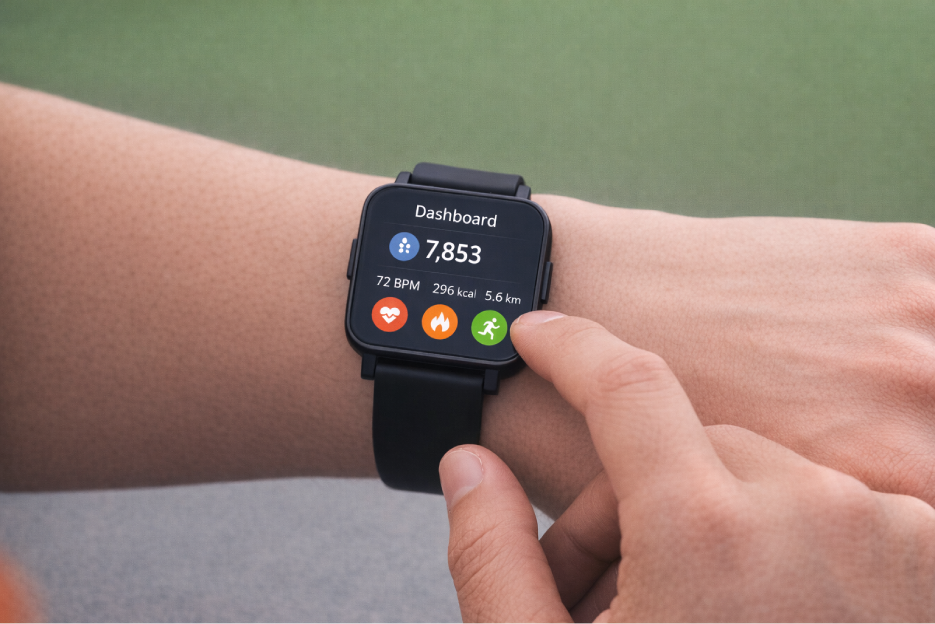
Digital products are under increasing pressure to meet expectations. Users want to access information immediately, perform actions without friction and use services even when their smartphone is not easily accessible – on the move, during training or with their hands full.
For product teams, this increasingly raises the question: Is the app still sufficient to meet these demands?
This is precisely where smartwatches and voice assistance can help. However, the decisive factor is not what is technically possible, but when an additional touchpoint really helps in the context of use – and when it does not bring any noticeable added value.
We at UID are convinced:
Successful extensions are created where the context of use, technical feasibility and economic benefit are considered together.
Recognizing potential along the customer journey
Whether smartwatches and voice assistance are really useful is rarely shown in a pure feature list. Relevant potential becomes visible where users are under time pressure, are on the move or only need short, clear interactions.
Journey Mapping helps teams to recognize precisely these moments – and to derive meaningful enhancements from them.

When a smartwatch app useful is
Smartwatches are usually only used for a few seconds. A glance at the display is brief, attention is limited and use is often situational. This is not a disadvantage – it is the real strength.
Smartwatch extensions are therefore particularly suitable for quick, simple and clearly defined interactions. They are particularly useful when users:
- need to be notified without needing the smartphone
- want to check a status quickly
- want to respond directly to a reminder
- have to start, pause or confirm a process
- need brief progress information
- cannot use the smartphone comfortably at the moment
The most important conceptual task is not to put as much as possible on the clock. The decisive factor is clear prioritization. Smartwatch apps are less suitable for complex configurations, longer texts, detailed analyses or high-precision tasks. Ideally, a view only fulfills one main function.
The basic rule is simple: complex tasks belong on the smartphone, quick actions on the watch. The smartwatch is not a miniaturized smartphone app. It is a separate usage context with its own logic.
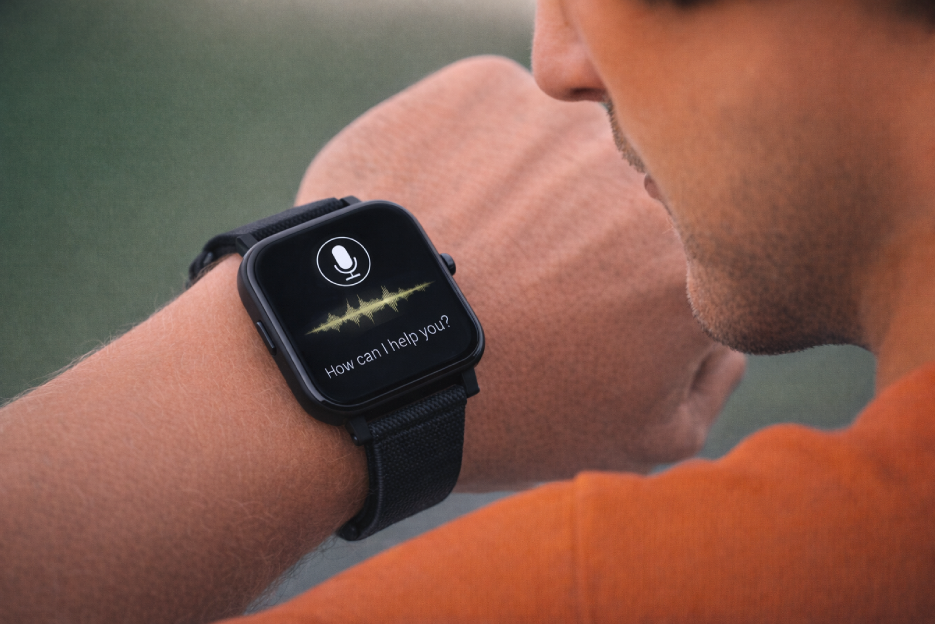
What The role of voice assistance
Voice assistance (Voice Interaction) is particularly useful when graphical operation is too slow or impractical. It does not necessarily have to be linked to a smartwatch: Smartphone apps canbe extended so that central functions can be used by voice – for example in situations where users have their cell phone with them but cannot or do not want to actively operate it.
On the smartwatch, voice interaction can do three things in particular: trigger actions, query status and shorten interactions. On the Smartphone it fulfills the same purpose – just in a different context of use. The decisive factor is not the device, but the moment in which speech noticeably facilitates interaction.
The added value is particularly important in situations with small displays, limited time and busy hands. At the same time, voice assistance plays an important role for the digital accessibility. For people with impaired vision, motor impairments or situational impairments, speech can make access to functions possible in the first place – and has long since ceased to be an optional feature in many contexts.
With increasing regulatory requirements, such as the German Accessibility Improvement Act (Barrierefreiheitsstärkungsgesetz), language support is increasingly becoming a relevant component of accessible interaction concepts. relevant component of barrier-free interaction concepts. It is important to note that voice assistance does not replace a graphical user interface. It complements it. It is usually not the right form of interaction for long content, complex processes or sensitive public situations – but as an additional access channel, it can make a decisive difference.
Technology and effort: as much as necessary, no more
Technically, smartwatch extensions are in many cases not completely new products, but extensions to existing systems. The watch takes over the display and fast interaction – logic, data storage and processing continue to run via the smartphone and backend.
Important for implementation include clean integration, stable synchronization, sensible offline capability, data protection and platform-specific requirements. The technical effort should always be measured against the context of use. Not every idea justifies its own watch or voice use case.
Anyone planning smartwatch extensions should realize early on that there is no single smartwatch platform. Apple Watch, Wear OS and other providers differ significantly in terms of interaction patterns, technical possibilities, system logic and distribution.
For product teams, this means that a smartwatch extension must either be be platform-specific or deliberately designed to work with reduced functionality on several systems. Decisions for or against certain functions are therefore not only conceptually but also strategically relevant.
At the same time, the question of the target group arises: which watch platforms do your own users actually use? Where is optimization worthwhile, and where does additional effort arise without corresponding added value?
Clean prioritization helps to avoid complexity. Instead of transferring every function to every system, it often makes more sense to clearly define the context of use and derive from this which core interactions must function independently of the platform – and where specific adaptations are useful or necessary.
When added value and cost-effectiveness come together
The added value of a smartwatch or voice assistant extensionis not created by the fact that an additional channel is technically available, but when a real user problem is solved better than before.
An extension is particularly useful if it improves a frequent moment of use, noticeably simplifies interactions and can be seamlessly integrated into existing systems. In the case of established apps, existing accounts, data models and backend structures often provide a solid basis for this.
Time for conscious decisions
Smartwatches and voice assistance do not create added value just because they are technically possible. Their value arises where they make existing apps faster, simpler and more relevant in specific situations.
The key lies in making the right choice: Which moments along the journey really benefit from a quick glance, a short action or a voice command?
Successful solutions combine three perspectives: context of use, technical feasibility and economic viability.
How UID provides support
UID helps companies to develop smartwatch and voice assistance enhancements in a targeted and user-centered way. Together with product and UX teams, we analyse relevant usage situations along the customer journey, prioritize meaningful touchpoints and translate these into viable concepts. In doing so, we combine UX strategy, conceptual depth and technical feasibility – always with an eye on cost-effectiveness and long-term added value.
The author
Lisa Reimer has been a Senior User Experience Consultant for over 15 years, supporting clients from various industries on their journey from the idea to the finished product or service. She primarily designs and evaluates suitable user interfaces. She also enables project teams to work innovatively and agilely. For example, she uses the co-creative process LEGO® SERIOUS PLAY® to promote new processes and ideas and to make collaboration inspiring. As a speaker at various events, Lisa passes on her knowledge of environment design and digital transformation.